Release the Forecasts
These Funding Opportunities Are Ready to Go. NIH Is Holding Them Back

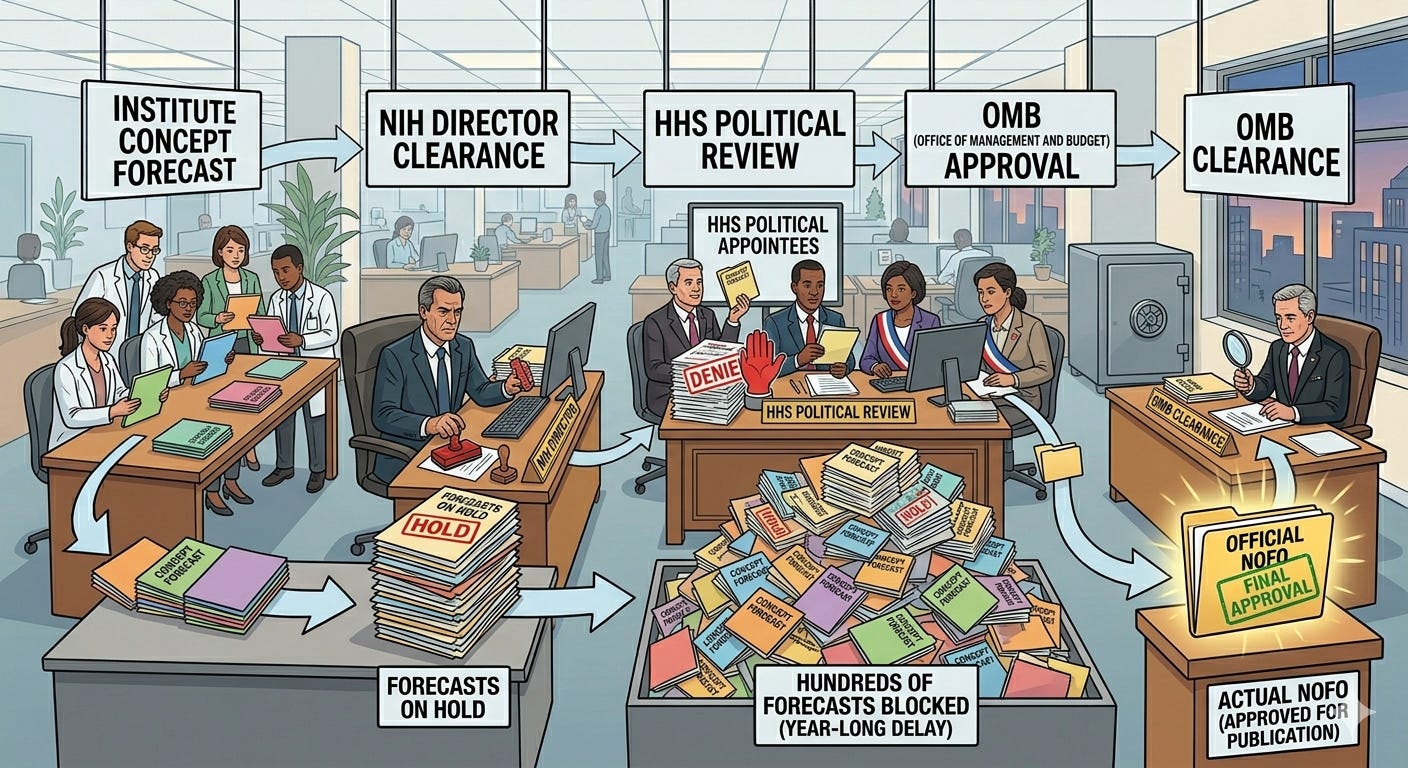
This image was generated by Google AI (Gemini)
Every funding opportunity described in the table linked below has been written. The science has been scoped, the eligibility requirements defined, the review criteria set. NIH scientific program and review officers did that work. They are ready to invite applications. Researchers are ready to apply.
These are not hypothetical programs waiting to be designed. They are fully developed Notices of Funding Opportunity (NOFO) forecasts sitting in a grants.gov queue, waiting for one thing: permission to be released.
Every program on this list has been supported or directed by Congress, through appropriations bill language, statutory set-asides, or sustained committee report directives over multiple fiscal years. Some carry mandatory funding floors that are legally non-discretionary. All of them represent research areas Congress has explicitly said matter: opioid use disorder, Type 1 diabetes, pediatric cancer, Down syndrome, environmental health, minority health, autism, and more.
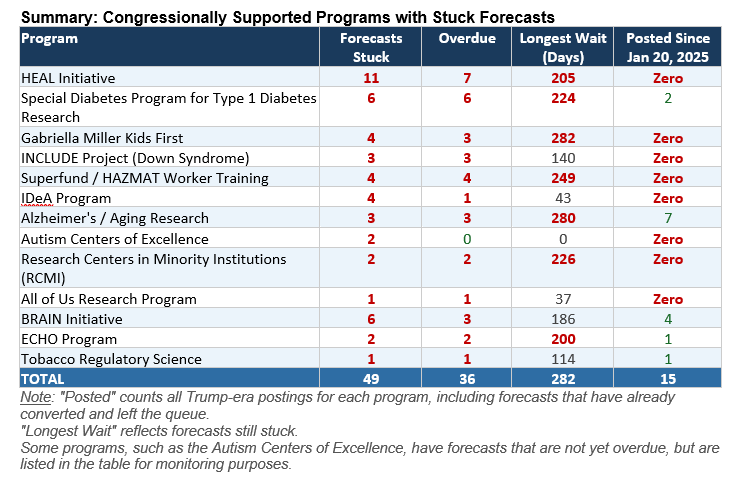
As of May 8, 2026, there are 49 forecasts related to 13 different congressionally directed programs that are all stuck in the queue. Of those, 36 are past the date NIH itself set for their publication. The HEAL Initiative for opioid research has 11 forecasts stuck and has published zero targeted NOFOs since the Trump administration took office. The Gabriella Miller Kids First program, named for a ten-year-old who died of a brain tumor and who inspired bipartisan legislation to fund pediatric cancer research, has three forecasts overdue by 282 days. The Special Diabetes Program, funded through a mandatory appropriation under the Balanced Budget Act of 1997, has six forecasts overdue.
NIH could release these forecasts as a full funding opportunities immediately. The science is ready. The staff work is done. The only thing standing between these forecasts and the researchers who would respond to them is an approval process that has held mandated programs in a political approval queue for the better part of a year.
The full list, with opportunity numbers, the date each forecast was entered into grants.gov, the date NIH originally promised to publish it, and the number of days it is now past that self-imposed deadline, is available for download at the link below.
In the master list (which you can download via the link below), please note that RED rows reflect forecasts that are overdue. YELLOW rows indicate forecasts that are not yet past their promised date, but I am including them in the table for monitoring purposes. For example, one program, the Autism Centers of Excellence, has two forecasts with July 1, 2026 planned posting dates, which will become overdue in approximately eight weeks if action is not taken. We will see if NIH honors these projected release dates.
Release the forecasts!
This essay is part of an ongoing series documenting changes to the NIH extramural funding system. Previous essays: The NOFO Pipeline Isn’t Broken. It’s Selective; Inside the NIH Forecast Graveyard; Who Decides What Science Gets Done? Data compiled from grants.gov as of May 8, 2026.
Do you have any insight to the PRIMED AI? The funding announcement was supposed to go out last fall.
Update 5/8/2026: I have been alerted about two additional forecasts that are part of a congressional mandate:
Best Pharmaceuticals for Children Act (BPCA)
BPCA became law in 2002. It was reauthorized in 2007 under the U.S. Food and Drug Administration (FDA) Amendments Act, in 2012 under the FDA Safety and Innovation Act, and again in 2017 under the FDA Reauthorization Act. The latest renewal of the BPCA legislation occurred in 2022.
NIH will not release these two BCPA related funding opportunities:
RFA-HD-26-009 - NICHD - forecast date 9/15/2025
Maternal and Pediatric Precision in Therapeutics (MPRINT) Knowledge and Research Coordination Center
RFA-HD-26-010 - NICHD - forecast date 9/15/2025
Maternal Medications and Human Milk Research Center (M2HMRC)
Both forecasts are 235 days overdue as of May 8, 2026 (their promised date was September 15, 2025).
These hold-ups of research are going to cost lives.